Agent-scoped credentials
An agent-scoped credential lets one registered AI agent use an approved upstream identity. The credential binding names that agent with an immutable agentSubject, limits where the credential can be used, and keeps the secret outside the MCP client.
Use this mode when the organization needs to answer:
- Which agent used the upstream credential?
- Which tools, servers, and environments could it access?
- Can security revoke that agent without disrupting other agents?
The problem with a shared service account
Section titled “The problem with a shared service account”Suppose five AI agents access Salesforce through one MCP server. If every agent uses the same service account, Salesforce sees one upstream identity. The gateway can still apply policy, but the shared credential creates a large revocation boundary and weakens agent-level accountability.
An agent-scoped binding narrows that boundary. The customer registers and approves an agent, then binds a credential reference to that agent. A different agent cannot resolve the binding.
Four identities in one request
Section titled “Four identities in one request”These identities have separate jobs:
| Identity | Example | What it tells the gateway |
|---|---|---|
| Human | Alice | Who initiated or delegated the work, when present. |
| Agent | Contract Review Agent | Which approved AI agent is acting. |
| Client surface | Claude Code, Cursor, or a custom MCP client | Where the request entered. The client is not automatically the agent. |
| Upstream identity | Salesforce integration identity | What the upstream service receives. |
The signed runtime identity can carry an agent ID, an optional agent instance ID, and an optional human delegator. The gateway keeps these identities distinct in policy and audit.
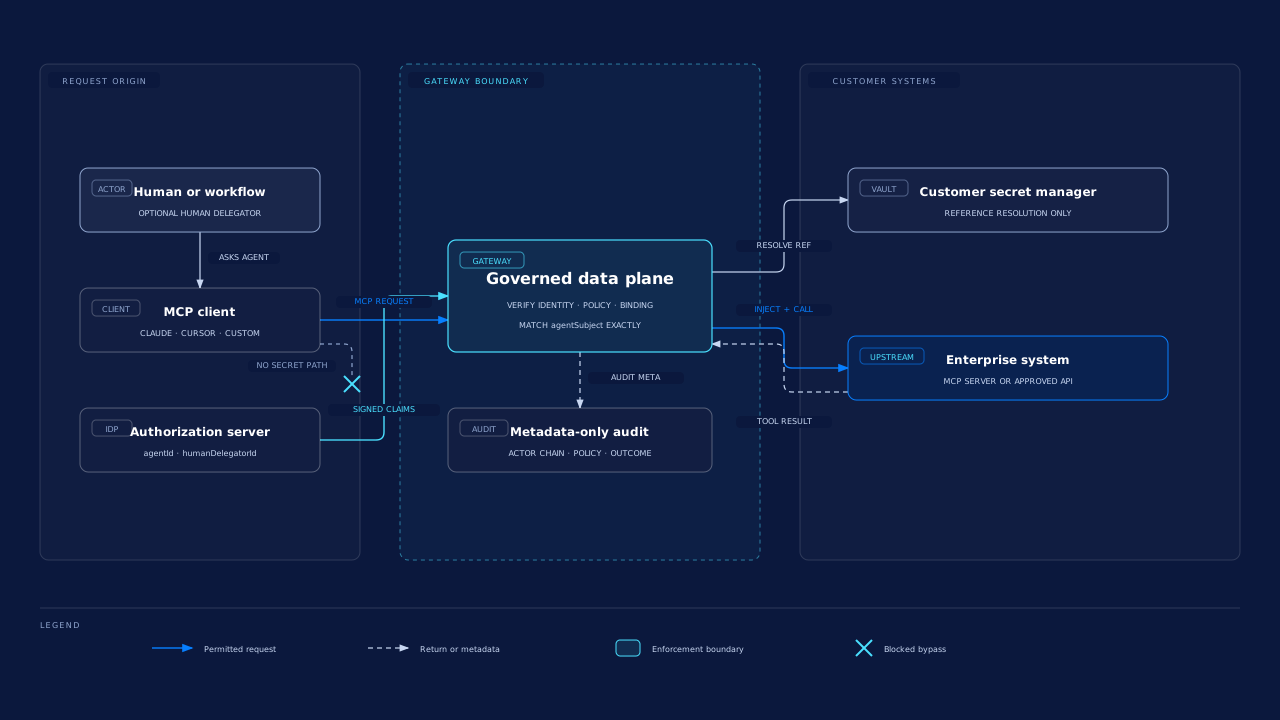
What the customer configures
Section titled “What the customer configures”- Register the agent. Record its owner, purpose, allowed environments, client surfaces, credential mode, and any instance rules.
- Approve the agent. Security reviews the operating boundary before the agent becomes eligible for a binding.
- Create the credential binding. Select
agent_scoped, choose the approved agent, reference the customer secret manager, and select the permitted MCP servers or API operations. - Attach policy. Policy still decides whether this agent may discover and call each tool in the current context.
- Activate the binding. Activation produces an approved runtime projection. Data planes do not infer access from an unapproved control-plane draft.
See Create a credential binding for the UI, API, and CLI workflow.
What happens during a tool call
Section titled “What happens during a tool call”The authorization server signs the runtime identity before the request reaches the data plane. A normal tool call does not require the MCP client to open an interactive login for every invocation.
During the call, the data plane:
- Verifies the token signature, issuer, audience, time bounds, and signed actor claims.
- Resolves the registered agent and optional agent instance.
- Evaluates policy for the agent, human delegator, client surface, environment, server, and tool.
- Matches the binding’s
agentSubjectexactly. - Resolves the referenced upstream credential through the credential broker.
- Injects the credential into the approved upstream request.
- Returns the tool result and emits metadata-only audit.
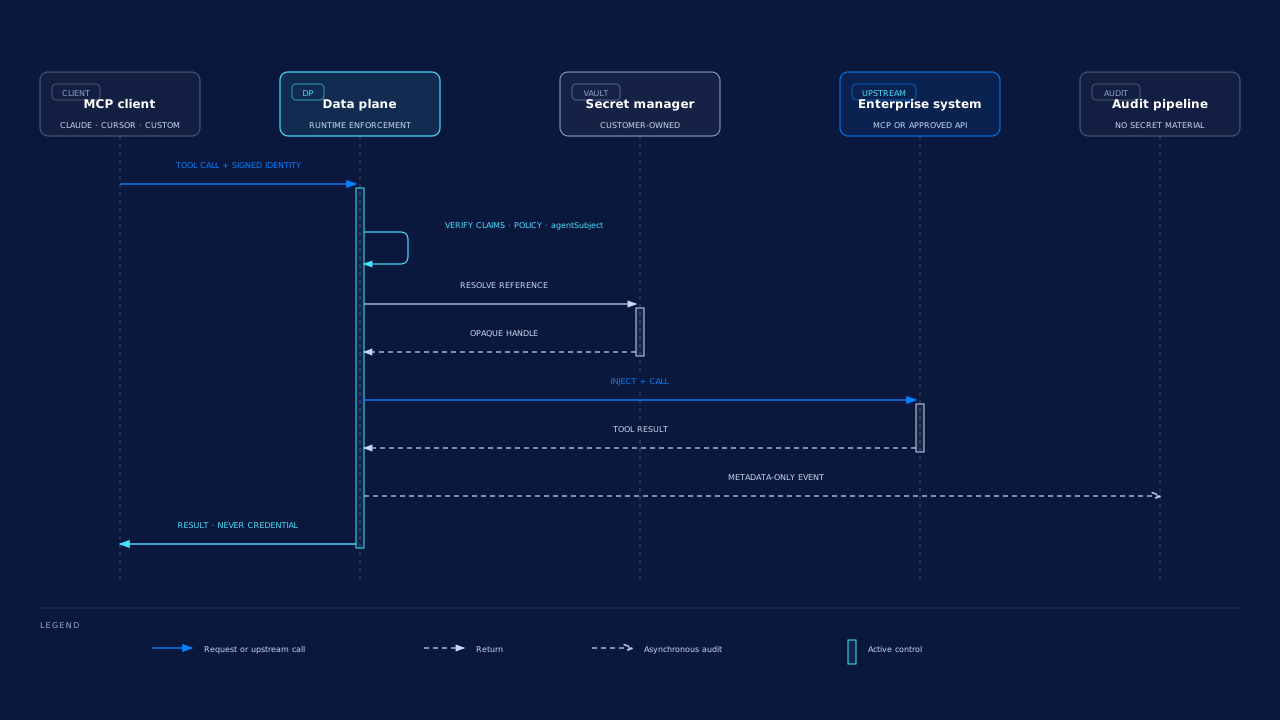
How the modes differ
Section titled “How the modes differ”| Credential mode | Upstream identity represents | Use it when |
|---|---|---|
service_account | A shared application or integration | Agent-level credential ownership is not required. |
user_delegated | The signed-in person | The upstream action must use the person’s delegated authority. |
agent_scoped | One registered agent | The agent needs an independent credential and revocation boundary. |
workload_mapped | A registered runtime workload | Infrastructure identity, rather than a human or agent, owns access. |
An agent can still act for a human. In that case, policy and audit retain both identities. The human delegation does not change ownership of an agent_scoped binding. A person signing in without a signed agent identity uses user_delegated instead.
Enforcement outcomes
Section titled “Enforcement outcomes”| Condition | Result |
|---|---|
Agent is approved and matches agentSubject | Continue to policy and credential resolution. |
| Agent claim is missing | Deny before credential resolution. |
| Agent is unknown, disabled, or revoked | Deny before the upstream call. |
| Agent is approved for another environment | Deny the binding activation or runtime request. |
| Required agent instance is missing or not allowed | Deny before credential resolution. |
| Policy denies the tool or surface | Hide the tool from discovery or deny the call. |
The gateway fails closed when identity, registry state, policy, or credential resolution is uncertain.
What appears in audit
Section titled “What appears in audit”Audit records safe metadata needed for investigation:
- authenticated human or service principal;
- agent ID and agent instance ID, when present;
- human delegator, when present;
- client surface and OAuth client ID;
- credential mode and binding ID;
- policy decision, reason code, server, tool, and upstream outcome.
Audit does not contain the secret, access token, private key, or raw credential material.
Revocation and incident response
Section titled “Revocation and incident response”If an agent is compromised, security can disable or revoke that agent. If only one upstream credential is affected, security can disable or revoke the binding. After the change reaches the runtime projection, new calls fail before credential resolution while unrelated agents and bindings continue operating.
Disabled and revoked bindings remain in the projection as inactive references for existing policies. This also applies to legacy agent-scoped bindings that lack an agent subject. These records carry no credential injection metadata; an active binding still requires a valid agent subject.
This gives security a smaller incident boundary than a service account shared by every agent.
Customer example: contract review
Section titled “Customer example: contract review”A legal team registers contract_review_agent and binds it to a Salesforce credential stored in the customer’s Vault. Policy allows two tools:
salesforce_read_accountsalesforce_create_case
The agent cannot use salesforce_delete_account. Another agent cannot reuse the credential binding. If security revokes contract_review_agent, its next governed call fails while other Salesforce agents continue using their own bindings.
Source truth
Section titled “Source truth”- Read Credential broker and modes for the complete mode model.
- Follow Create a credential binding to configure a binding.
- Read Agents for registration, discovery, and revocation.
Amelfi documentation · Space Grotesk / Geist Mono