Runtime configuration delivery
Configuration changes become live only after a managed data-plane replica has accepted a new runtime projection. This is how MCP Gateway moves an approved policy, server, credential-binding or Consumer OAuth change from the control plane to the runtime that serves your tools.
What starts a change?
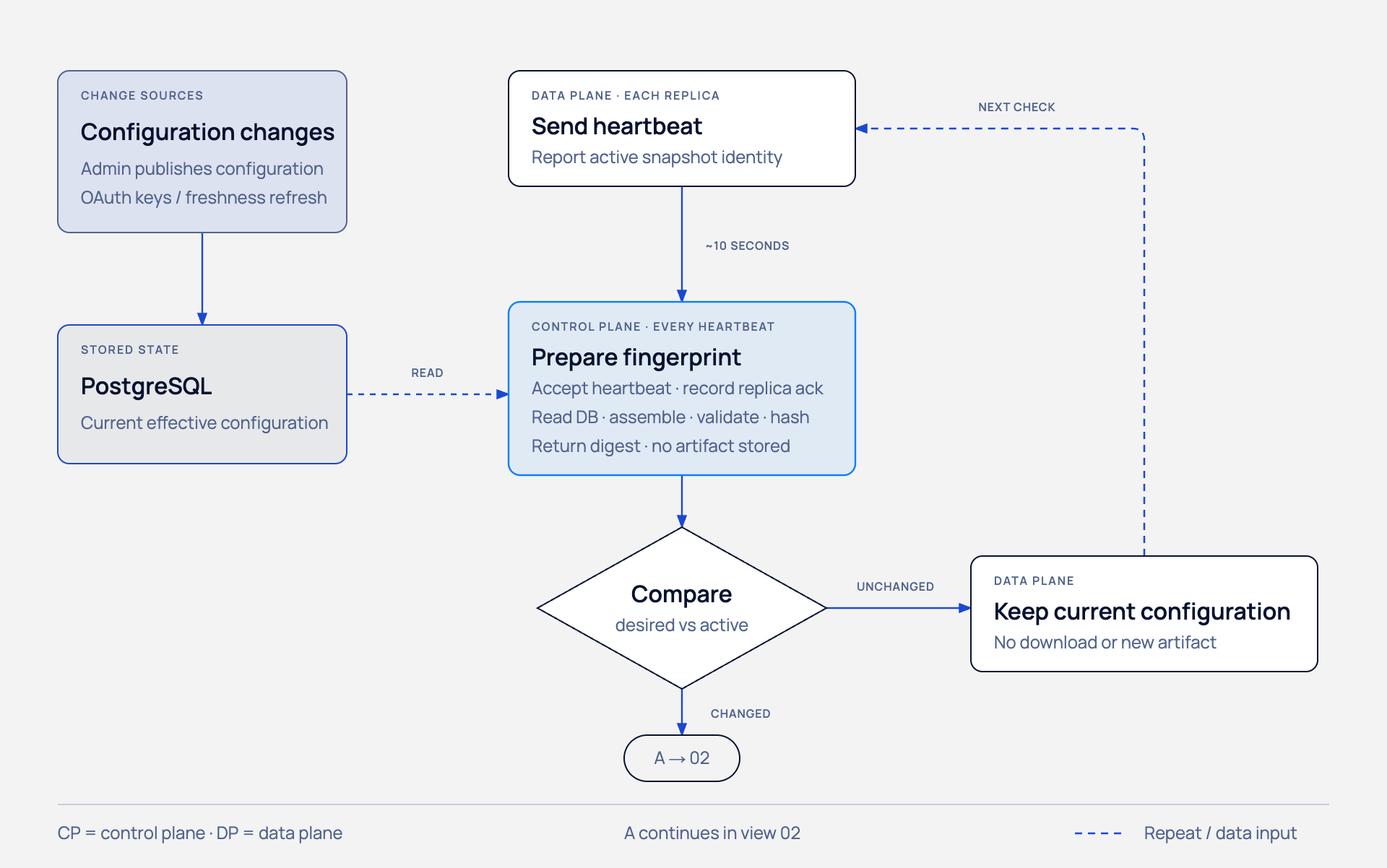
Section titled “What starts a change?”The control plane holds the approved configuration for a tenant, environment and data plane. A new policy, approved server configuration, credential-binding change, Consumer OAuth configuration change, revocation, or refreshed authorization-server key state can change the runtime projection.
The data plane does not make those decisions locally. It receives the desired state from the control plane through its authenticated Fleet session.
How the check works
Section titled “How the check works”Each managed replica sends a Fleet heartbeat with the identity of its active snapshot. The control plane accepts the heartbeat, records the replica’s activation state, reads the current effective configuration, validates it and calculates a configuration fingerprint.
The heartbeat response carries that desired fingerprint.
- If it matches the replica’s active fingerprint, the replica continues serving with its current configuration. It does not download a full projection or create a new delivery artifact.
- If it differs, the replica asks for a full snapshot.
The heartbeat interval is an operational setting. Treat the next accepted heartbeat as the normal propagation mechanism, rather than relying on a fixed customer-facing latency promise.
When a full snapshot is needed
Section titled “When a full snapshot is needed”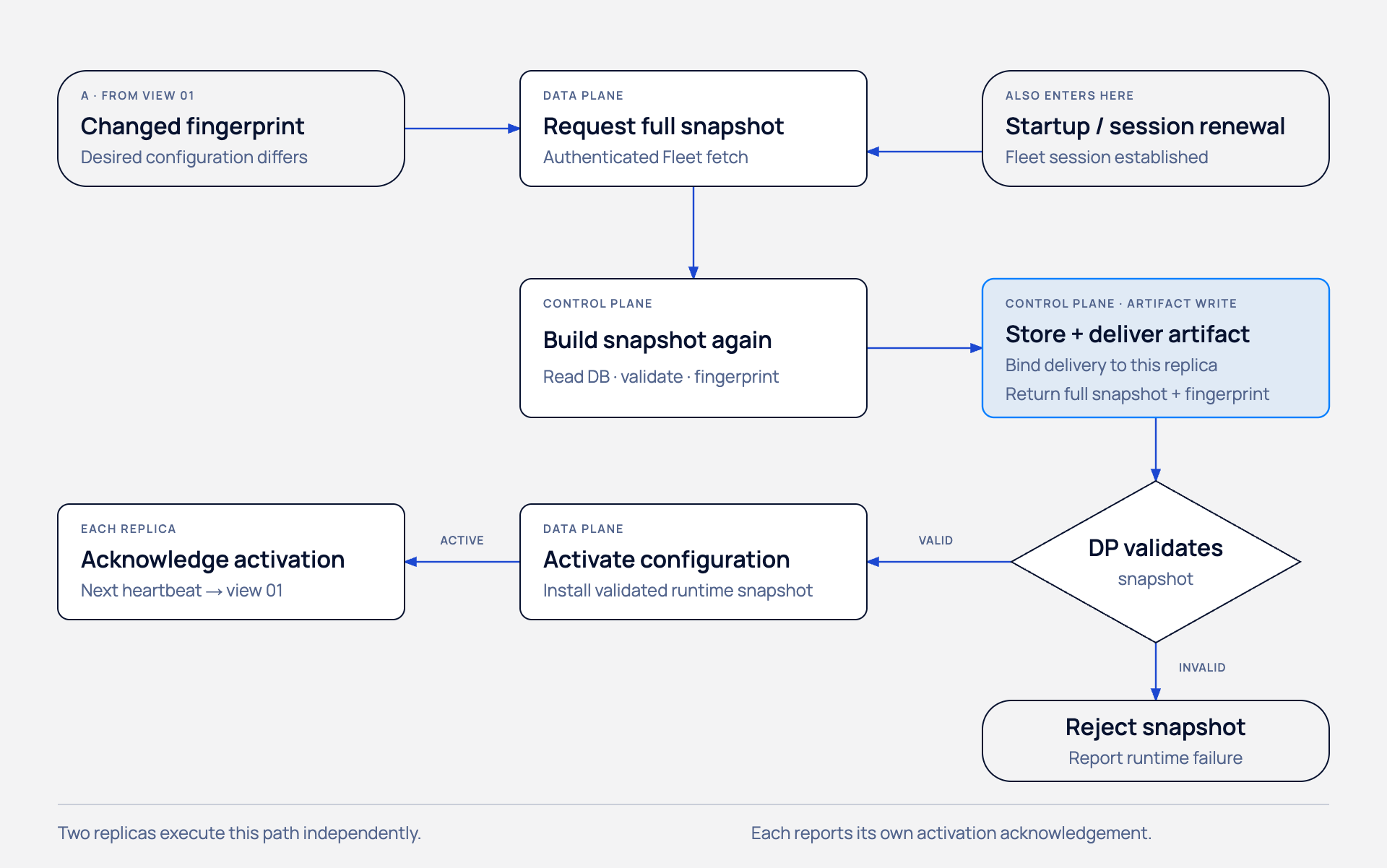
For a full fetch, the control plane builds and validates the projection again, stores an immutable delivery artifact and binds that delivery to the specific replica. The replica validates the document before activation. Its next heartbeat acknowledges the activation back to the control plane.
What this means for operators
Section titled “What this means for operators”When a configuration change appears not to have reached a tool call, check the data plane’s readiness and projection state before changing policy or credentials again. A healthy replica should show an accepted heartbeat and the expected active projection after it has activated the new snapshot.
Each replica follows this process independently. During a rollout or recovery, replicas can acknowledge at different times. The control plane tracks those acknowledgements instead of assuming that one replica’s update proves the fleet has converged.
Managed and self-hosted boundaries
Section titled “Managed and self-hosted boundaries”This Fleet handshake describes the managed data-plane path. Self-hosted deployments use their configured runtime-projection source and keep the same safety rule: the data plane enforces only a valid, approved projection and fails closed after the allowed freshness window.
Source truth
Section titled “Source truth”- Read Control plane vs data plane for the ownership boundary.
- Read Check deployment status when a change has not reached a replica.
- Read Audit & investigation for the metadata recorded around governed calls.
Amelfi documentation · Space Grotesk / Geist Mono